
Rain Gardens in Newport, RI: Designing Water to Stay on the Land
A low spot that stays wet is not a problem to pipe away. It is the beginning of a garden.

Every spring I get the same call. There is a corner of the lawn that never dries out, a downspout that has cut a channel through a bed, a terrace that sheets water toward the house. The usual answer is a pipe: catch it, bury it, send it to the street. I would rather keep it. Rain that falls on a property is the cheapest water that garden will ever get, and a rain garden is a way of holding it long enough to soak in. Done well, it looks like the best planting on the property, not a piece of drainage.
What a rain garden actually is
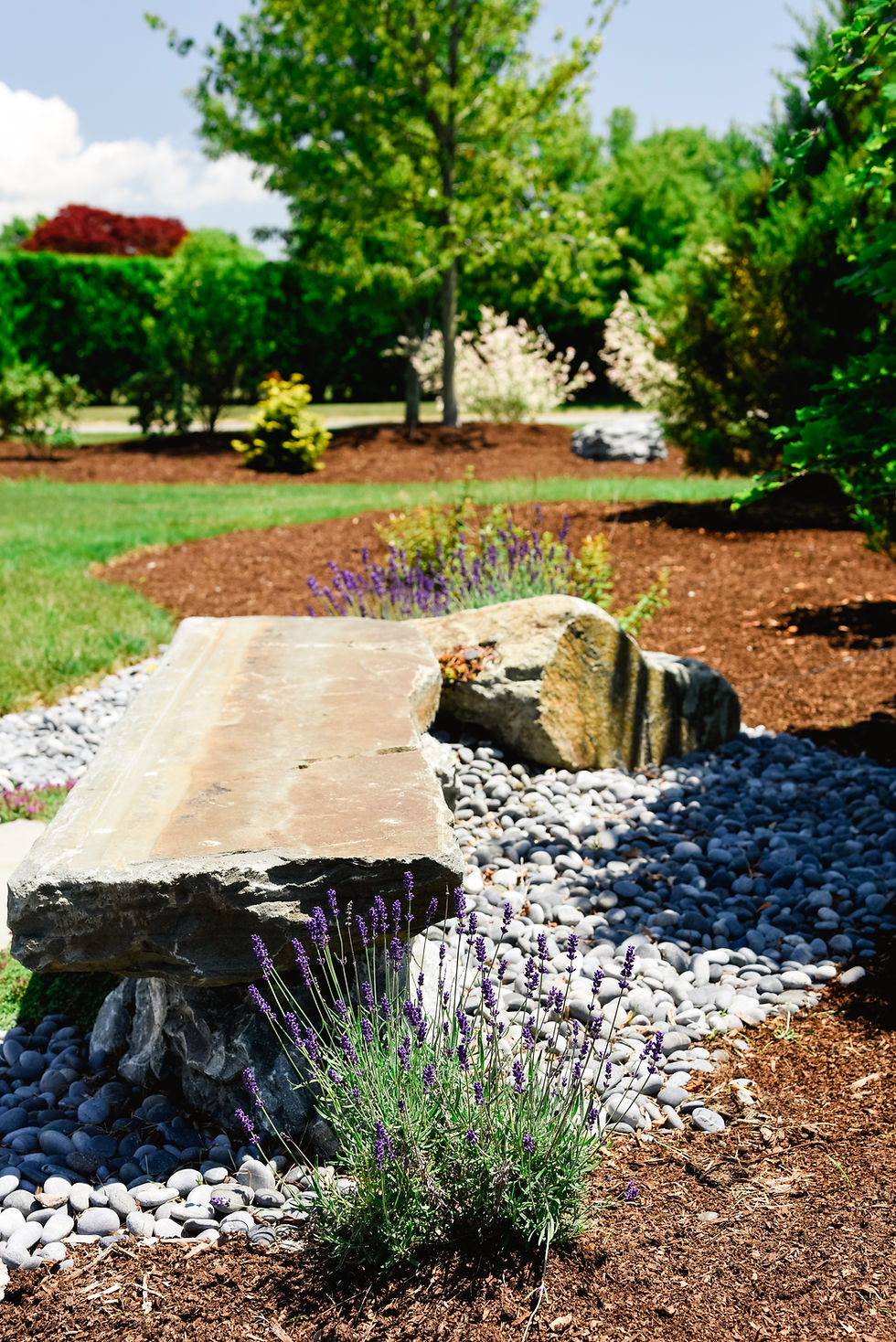
A rain garden is a shallow, planted basin set where water naturally wants to go. Runoff from a roof, a drive or a terrace is led to it by a swale or a dry stream bed of river stone, it pools for a few hours after a storm, and it drains into the soil within a day. The plants do most of the work. Their roots open the ground so it takes water faster, they drink a good share of it, and they filter what runs through. There is no standing water, so there is no mosquito problem, and there is no pump, so there is nothing to fail.
Why they suit this island
Aquidneck Island is a hard place to move water. There is ledge close to the surface in Newport and Middletown, pockets of clay in Portsmouth, sand near the beaches, and everywhere the land tips toward the bay. Many of our properties sit close enough to the water that the CRMC takes an interest in where runoff goes. A rain garden answers all of that at once. It slows the water down on the property instead of sending it off the edge, it keeps silt and fertilizer out of the bay, and it recharges the ground that our trees and hedges drink from in August. On a coastal lot it is often the single most useful thing we build.

Rain that falls on a property is the cheapest water that garden will ever get.
How we build one
We start by watching where the water already goes, ideally during a storm. Then we dig the basin a little deeper than it looks like it needs, amend the soil so it drains, and shape the edges with boulders and fieldstone so it reads as a garden rather than a ditch. The stone matters. A rain garden edged in granite from the region looks like it has always been there. Then we plant thick. Switchgrass, little bluestem, blue flag iris, joe-pye weed, winterberry and red twig dogwood are all at home with wet feet in April and dry ground in August, and they carry the garden through four seasons without asking for much.
The rain garden at Marble House
In 2026 the Preservation Society of Newport County recognized our rain garden at Marble House with its Laurel Award for Horticulture. I am proud of that one for a simple reason. It manages runoff on one of the most looked-at properties in Newport with plants and stone rather than pipes, in a way that belongs to the place. That is the whole idea. A rain garden should be the part of the property people walk over to look at, not the part they walk around.
Beginning your project
If there is a corner of your property that stays wet, or a downspout that has been running into the same bed for years, that is a good place to start a conversation. You can see more of our water work and planting, or read about how I approach coastal landscape design. We work across Newport, Middletown, Portsmouth, Jamestown, Little Compton and Southeastern Massachusetts. Call me at 401-619-1607 or request a consultation.


Comments